Chapters 7-9: Labour-power, constant and variable capital, and the rate of surplus-value
- Dec 11, 2017
- 13 min read
Hello dear friends,
We're getting into things properly now in Marx's analysis of the capitalist mode of production!
To recap, at the end of Chapter Six, we left our two 'dramatis personae' - the capitalist and the worker - on their way from the hustle and bustle of the open marketplace heading to the 'hidden abode' of the factory with Marx insisting that we had to go inside the factory in order for the 'secret of profit-making to be revealed'.
Chapter Seven : The Labour Process and the Valorization Process
Right at the beginning of Chapter Seven, Marx reminds us of the key argument in Chapter Six:
'The use of labour-power is labour itself. The purchaser of labour-power consumes it by setting the seller of it to work. By working, the latter becomes in actuality what previously he only was potentially, namely labour-power in action, a worker.'
The source of profit (surplus value, in Marx's terms) lies in the existence of a commodity that produces more value when consumed in production. That commodity is labour-power - the worker's capacity to labour. The capitalist buys it from the worker (a worker who must be free to sell it and 'free' from the possession of any other commodity to sell instead) and puts it to work in a process of production.
Now, before we go any further into this analysis, Marx takes time to lay the foundations of a historical materialist philosophy by setting out the transhistorical and universal basis of any labour process, regardless of the society, of the mode of production in question:
'Labour is, first of all, a process between man and nature, a process by which man, through his own actions, mediates, regulates and controls the metabolism between himself and nature. He confronts the materials of nature as a force of nature. He sets in motion the natural forces which belong to his own body, his arms, legs, head and hands, in order to appropriate the materials of nature in a form adapted to his own needs. Through this movement he acts upon external nature and changes it, and in this way he simultaneously changes his own nature.
So, labour is what Marx describes later in this chapter as the 'universal condition for the metabolic interaction [Stoffwechsel] between man and nature, the everlasting nature-imposed condition of human existence, and it is therefore independent of every form of that existence, or rather it is common to all forms of society in which human beings live'

The second crucial point here is that when we labour, we simultaneously transform ourselves. Making is remaking. This means very clearly that the most important thing are the social relations of production, i.e. the ethical and political relations that structure who owns, who manages, who controls, who labours, who consumes, etc and determine whether we live in conflict or harmony with each other and our planet. This leads Marx a few pages later to insist that human epochs should be characterised not by the materials worked with (e.g. Stone or Bronze Age), but by the instruments of labour' because 'they...indicate the social relations within which men work'.
Marx goes on:
'We presuppose labour in a form in which it is an exclusively human characteristic. A spider conducts operations which resemble those of the weaver, and a bee would put many a human architect to shame by the construction of its honeycomb cells. But what distinguishes the worst architect from the best of bees is that the architect builds the cell in his mind before he constructs it in wax. At the end of every labour process, a result emerges which had already been conceived by the worker at the beginning, hence already existed ideally. Man not only effects a change of form in the materials of nature; he also realizes [verwirklicht] his own purpose in those materials. And this is a purpose he is conscious of, it determines the mode of his activity with the rigidity of a law, and he must subordinate his will to it. This subordination is no mere momentary act. Apart from the exertion of the working organs, a purposeful will is required for the entire duration of the work. This means close attention. The less he is attracted by the nature of the work and the way in which it has to be accomplished, and the less, therefore, he enjoys it as the free play of his own physical and mental powers, the closer his attention is forced to be.'
Again, crucial stuff. The thing that distinguishes human labour processes from all other animal labour processes is that human beings consciously design their production beforehand. 'Is this an anthropocentric (human-centric) stance?' asked On Hee in our session? It could well be based on an anthropocentric definition and understanding of intelligence - one that could well come to be challenged...
What I what to emphasise here is that because labour requires purpose and design, it requires concentration. This means that the more one is attracted to the nature of the work, the more one is likely to stick at it and do it well. This means, in turn, that the more one experiences the work as 'free play', the better. This is really radical and resonates with growing movements to take play seriously and reintegrate play and and ethos of playfulness right back into the heart not just of kids' learning, but of adult learning and all adult work. I couldn't agree more.
Marx goes on to name the three elements in any labour process: '(1) purposeful activity, that is work itself, (2) the object on which that work is performed, and (3) the instruments of that work.' He says that the labour process is 'extinguished in the product' and that the labour expended becomes 'bound up in the object' or 'objectified': 'What on the side of the worker appeared in the form of unrest now appears, on the side of the product, in the form of being, as a fixed, immobile characteristic. The worker has spun, and the product is spinning.' This leads Marx to conclude that:
'If we look at the whole process from the point of view of its result, the product, it is plain that both the instruments and the object of labour are means of production and that the labour itself is productive labour.'
What follows is a key concept to take on board as the analysis develops. Marx says that:
'Although a use-value emerges from the labour process, in the form of a product, other use-values, products of previous labour, enter into it as means of production...With the exception of the extractive industries, such as mining, hunting, fishing...all branches of industry deal with raw material, i.e. an object of labour which has already been filtered through labour, which is itself already a product of labour.'
So, labour is the process of active human labour-power working on a product with instruments that themselves contain the objectified labour of former labour processes, and in this process some of that past labour is transferred by the living labour into the new product. We don't think about this past labour at all, Marx points out, unless something goes wrong with our instruments and then we remember alright!
Now, this past labour will never get transferred to the new product unless it is incorporated into a labour process:
'Iron rusts, wood rots. Yarn with which we neither weave nor knit is cotton wasted. Living labour must seize on these things, awaken them from the dead, change them from merely possible into real and effective use-values.
Now, back to the specifics of the capitalist mode of production...
In the 'Kist MOP', as is the oft-used shorthand, 'the worker works under the control of the capitalist to whom his labour belongs' and 'the product is the property of the capitalist and not that of the worker, its immediate producer'. In this process, 'the capitalist incorporates labour, as a living agent of fermentation, into the lifeless constituents of the product, which also belong to him'.
Before he gets into 'The Valorization Process' properly, Marx begins the second half of Chapter 7 with another crucial point: the capitalist wants to produce a use-value, but only has an instrumental interest in that use-value, i.e. she only cares about the product insofar as and in as much as it also has exchange-value:
'Use-values are produced by capitalists only because and in so far as they form the material substratum of exchange-value, are the bearers of exchange-value. Our capitalist has two objectives: in the first place, he wants to produce a use-value which has exchange-value, i.e. an article destined to be sold, a commodity; and secondly he wants to produce a commodity greater in value than the sum of the values of the commodities used to produce it, namely the means of production and the labour-power he purchased with his good money on the open market. His aim is to produce not only a use-value, but a commodity; not only use-value, but value; and not just value, but also surplus-value.'
This cannot be emphasised enough. Even if some of their employees do and might think their company does, Nike don't make shoes, Glaxo don't make drugs, McDonald's don't make 'food' for their own sake; they make them to sell them and to make profit from them.
Anyway, back to the labour process in the capitalist MOP. So, we've got workers expending their labour-power to use instruments containing past labour in order to produce a new product containing a combination of a quantum of that past labour and a quantum of new labour. That means we can begin to quantify this process. Hence:
'Definite quantities of product, quantities which are determined by experience, now represent nothing but definite quantities of labour, definite masses of crystallized labour-time. They are now simply the material shape taken by a given number of hours or days of social labour'.
And so, Marx gives an example of a capitalist paying a worker 3 shillings to work for six hours on spinning cotton into yarn. If 3 shillings is the cost of labour-power, i.e. the socially average cost for the worker to reproduce herself, then no surplus-value is produced. However...
'The fact that half a day’s labour is necessary to keep the worker alive during 24 hours does not in any way prevent him from working a whole day. Therefore the value of labour-power, and the value which that labour-power valorizes [verwertet] in the labour-process, are two entirely different magnitudes; and this difference was what the capitalist had in mind when he was purchasing the labour-power.'
So, the whole point of purchasing workers' labour-power is to make them work longer - as long as possible - than the labour time it takes the workers to reproduce themselves (socially necessary labour-time)! Now, see what happens when the capitalist sets the worker to spin cotton into yarn for not 6 but 12 hours!...
'Now five days of labour are objectified in this 20 lb. of yarn; four days are due to the cotton and the lost steel of the spindle, the remaining day has been absorbed by the cotton during the spinning process. Expressed in gold, the labour of five days is 30 shillings. This is therefore the price of the 20 lb. of yarn, giving, as before, 1s. 6d. as the price of 1 lb. But the sum of the values of the commodities thrown into the process amounts to 27 shillings. The value of the yarn is 30 shillings. Therefore the value of the product is one-ninth greater than the value advanced to produce it; 27 shillings have turned into 30 shillings; a surplus-value of 3 shillings has been precipitated. The trick has at last worked: money has been transformed into capital.'
This is the process of valorisation - the turning of value into more value, the creation of surplus-value.
'By turning his money into commodities which serve as the building materials for a new product, and as factors in the labour process, by incorporating living labour into their lifeless objectivity, the capitalist simultaneously transforms value, i.e. past labour in its objectified and lifeless form, into capital, value which can perform its own valorization process, an animated monster which begins to ‘work’, ‘as if its body were by love possessed’
This is one of many references to monsters, werewolves, vampires in this book. I'll be sure to point others out too. They were the inspiration behind David McNally's incredible book Monsters of the Market, which won the Isaac Deutscher prize a few years ago.
Now, remember where this book started back at Chapter One? With the commodity and with Marx pointing out the dual form of the commodity - use-value and exchange-value. Well, here's an interesting point:
'Just as the commodity itself is a unity formed of use-value and value, so the process of production must be a unity, composed of the labour process and the process of creating value [Wertbildungsprozess].'
So, in the capitalist production process, the labour process 'consists in the useful labour which produces use-values. Here 'the movement of production is viewed qualitatively' - use-values are about the qualities they possess or offer, e.g. the comfort of a chair, the nutrition and taste of a food. In stark contrast, viewed as a value-creating process - the process that the capitalist cares and really only cares about - the labour process 'appears only quantitatively' i.e. the period during which the labour-power is expended. Again, Marx emphasises brilliantly here the tragedy of a society, and a species, producing with concern not for quality, but for quantity and profit.
Chapter Eight: Constant Capital and Variable Capital
I shall summarise Chapters Eight and Nine far more succinctly. However, Marx here introduces three absolutely central terms for his analysis, namely constant capital, variable capital, and surplus-value. So, pay attention :)
Marx starts with constant capital. He reminds us that labour 'raises the means of production from the dead merely by entering into contact with them, infuses them with life so that they become factors of the labour process, and combines with them to form new products'. He then points out that the rate at which the 'dead' or past labour objectified in the instruments of labour is transferred into the new products depends on the rate at which the instruments deteriorate. Just like our own lives, we can't know for sure the length of a machine's life, but that doesn't stop insurance companies calculating averages and selling us insurance policies for both! So, again, we work on averages. If a machine costs £1,000 and lasts for 1000 days, 1/1000 of its value is transferred into the products it is used to produce each day. But, machines never, ever 'transfer more value to the product than they themselves lose during the labour process by the destruction of their own use-value'. This is crucial. Put simply, it means that tools or machines, however sophisticated, do not create value; only human labour creates value.
This leads Marx to define his two terms 'constant' and 'variable' capital:
'That part of capital, therefore, which is turned into means of production, i.e. the raw material, the auxiliary material and the instruments of labour, does not undergo any quantitative alteration of value in the process of production. For this reason, I call it the constant part of capital, or more briefly, constant capital.
On the other hand, that part of capital which is turned into labour-power does undergo an alteration of value in the process of production. It both reproduces the equivalent of its own value and produces an excess, a surplus-value, which may itself vary, and be more or less according to circumstances. This part of capital is continually being transformed from a constant into a variable magnitude. I therefore call it the variable part of capital, or more briefly, variable capital. The same elements of capital which, from the point of view of the labour process, can be distinguished respectively as the objective and subjective factors, as means of production and labour-power, can be distinguished, from the point of view of the valorization process, as constant and variable capital.'
So, put plainly, constant capital is called 'constant capital' because the quantity of its value does not change in the production process, whereas variable capital is so named because, during the production process, it not only reproduces itself, but produces an excess, a surplus-value, and the values of both the labour-power and the surplus vary according to many factors.
Chapter Nine: The Rate of Surplus-Value

Now, Marx gets mathematical. One fundamental goal of Capital for Marx was to lay scientific foundations for the discipline of critical political economy - scientific foundations to challenge the 'vulgar' bourgeois methods of classical political economy which were to later become the (even more vulgar!) discipline of economics. This is my weak point, I confess! I leave it to other, great Marxist economists here. Personally, I love the work of Michael Roberts - the only Marxist economist working in the City of London. I read his blog, 'The Next Recession', avidly.
So, we've got the following formulae in which: C = Capital advanced; c = constant capital (means of production); v = variable capital (labour-power); and s = surplus value...
C = c+v - Before the production process starts, the capital advanced is made up of the costs of the means of production and labour-power.
C' = (c+v) + s - After the production process, surplus-value is created, so C is transformed to C' (Capital becomes more capital; value is valorised)
v+s - The new value created is not c + v + s because constant capital creates no value. it's v + s
s/v - The rate of surplus value is therefore obtained by dividing the amount of surplus-value by the cost of the labour-power. So, if I pay a worker £100 to work 10 hours and she produces commodities I then sell for £120, this makes a rate of surplus-value of 20/100 = 20%. So 'the rate of surplus-value (s/v) is therefore an exact expression for the degree of exploitation of labour-power by capital, or of the worker by the capitalist'. Note exploitation is used generally as an emotive term. Here, it is a technical term.
Now, Marx provides us with a few more concepts:
The period of the working day during which the reproduction of the worker takes place he calls 'necessary labour-time', and the labour expended he calls 'necessary labour'. Thus, the work that creates surplus-value Marx calls 'surplus labour' and the period during which it is created he calls 'surplus labour-time'. Finally, 'we call the portion of the product that represents surplus-value by the name of 'surplus product'.
'What distinguishes the various economic formations of society – the distinction between for example a society based on slave-labour and a society based on wage-labour – is the form in which this surplus labour is in each case extorted from the immediate producer, the worker'
So, there we have it. Marx has provided us with the technical foundations for understanding our own specific historical form of class society - the capitalist mode of production - not the first society in which a particular class produces a surplus for another/others, but the first in which production for exchange-value rather than use-value dominates.
We begin to see quite starkly why this book, its writer, and its readers have been demonised, ridiculed, and attacked so relentless. Marx has shown quite clearly that we spend most, if not a large part of our days working to produce surplus for capital and those who own it (and are owned by it). He has revealed the structural antagonism at the foundation of our society. He now goes on in Chapter Ten to show how this antagonism plays out in such painful ways each day in the workplace.
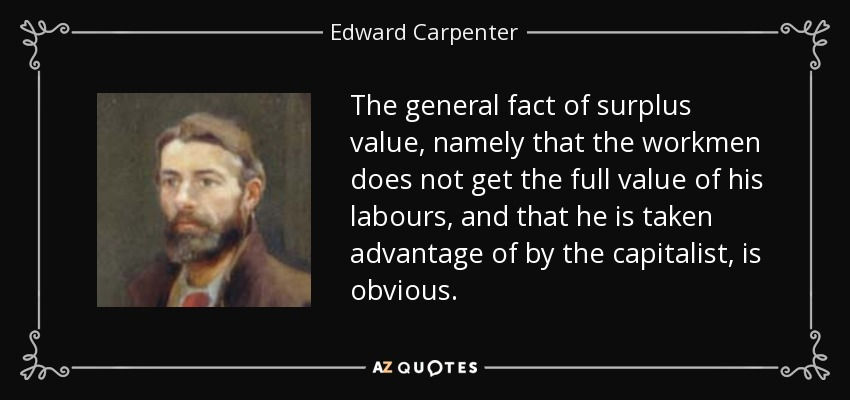
At the same time, the truth he systematically and scientifically demonstrates is, on another level, no revelation at all. I mean, it's patently obvious. Here's how early socialist, philosopher, poet, and gay rights advocate, Edward Carpenter put it:
Before I sign off, I wanted to tell you about one element of our session. We had a wide-ranging discussion - some themes more relevant to the book than others. At one point in the session, I felt as if I really wanted to explain the political significance of what Marx was talking about. With permission from my co-readers, I went on for 10-15mins, offering an explanation of the Global Financial Crisis of 2008 with just c, v, and s as my starting point. I won't reproduce that explanation here. Instead, I will offer you this wonderful RSA Animate video of David Harvey explaining the Crisis, which covers quite a bit of the stuff I covered. Check it out! It's brilliant!
Tune in next week - the last for 2017 - for Chapter Ten: The Working Day!
Thanks for reading
Joel




Comments